


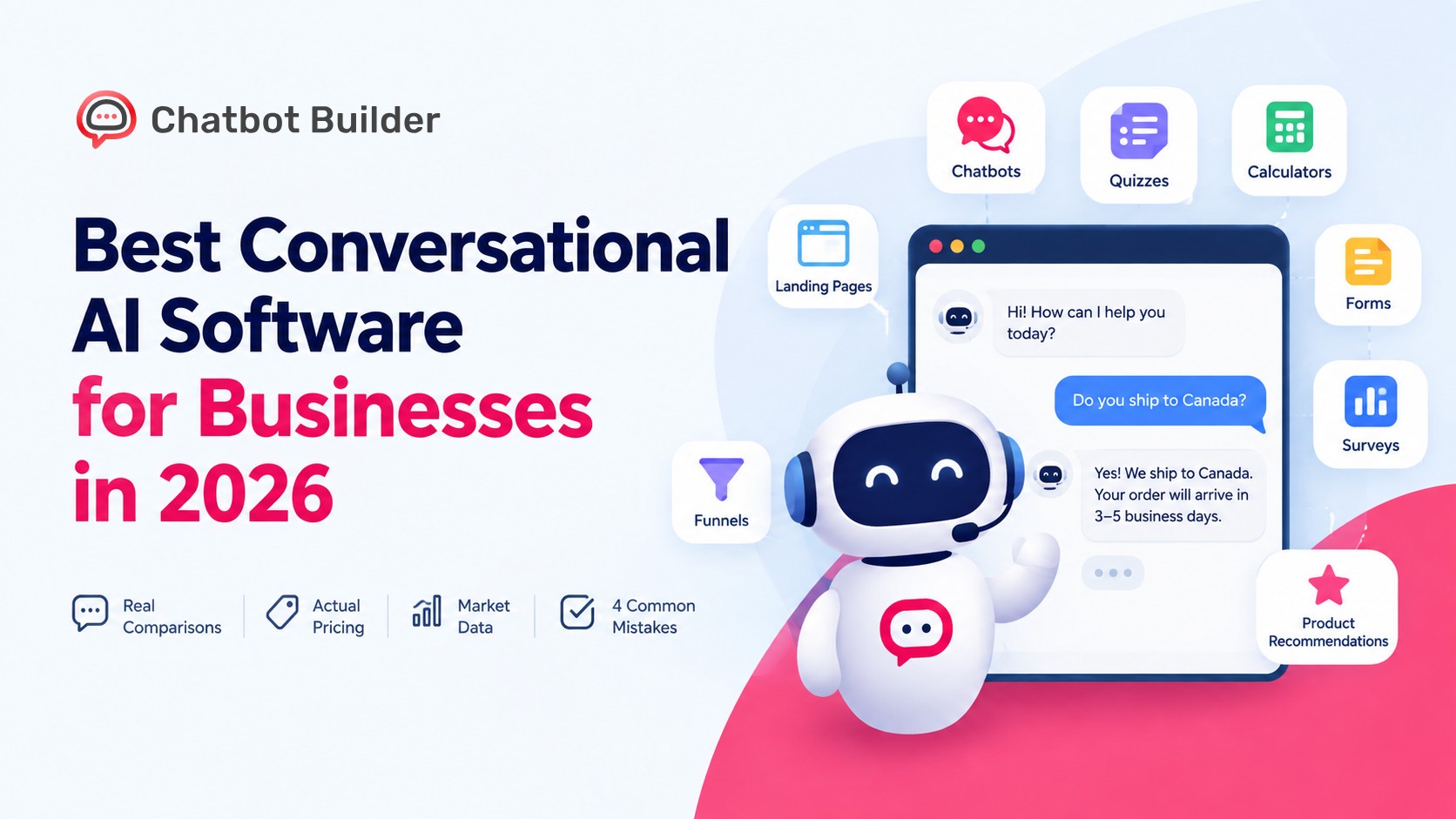
It’s 11:47 p.m. A customer wants to know if you ship to Canada. Your team is asleep.
A few years ago, that question sat in an inbox until morning, and by then the customer had bought it from someone else. Today, conversational AI software answers in seconds, in plain language, and often closes the sale before your coffee is brewed.
The catch is that dozens of platforms promise the same thing. Most businesses pick one the way people pick a gym membership: fired up on day one, barely using it by week three.
At ChatbotBuilder.net, our job is to shorten that decision. This guide gives you the market data, real 2026 pricing, nine platforms matched to specific business types, starting with our own so you can see exactly where it fits and where it doesn’t, and a 30 day launch plan.
The quick answer
The best conversational AI software depends on your stack and your team:
- Small or mid size business that wants a no code bot live this week: ChatbotBuilder.net
- Support team that wants an AI agent fast: Fin (formerly Intercom)
- Already on Zendesk: Zendesk AI agents
- High volume consumer brand: Ada
- Developer or technical founder: Botpress
- Designers and CX leads building together: Voiceflow
- Large enterprise with governance needs: Kore.ai
- Microsoft 365 company: Microsoft Copilot Studio
- Voice heavy contact center on Google Cloud: Google Dialogflow CX
Details, prices, and trade offs follow.
What conversational AI software actually does
Conversational AI software lets people talk to your business in normal language, by chat or voice, and get real answers or real actions. Think “Where’s my order?” followed by a live lookup, or “Can I move my appointment to Thursday?” followed by a rebooked slot.
Old chatbots followed decision trees. Click a button, get a canned reply, hit a dead end, rage quit. Modern platforms run on large language models, read your help articles and product data, and handle messy questions the way a decent new hire would.
The numbers behind the hype
Neil Patel’s rule applies here: look at the data before you spend a dollar.
The market is large and growing fast: Grand View Research estimates the market at $17.7 billion in 2026, growing to $78.9 billion by 2033 at a 23.8% annual rate. Research firms disagree on the exact figure. Research and Markets sees $17.12 billion in 2026 and $42.51 billion by 2030. Either way, the direction is the same.
Automation is cheaper than a human touch: Gartner’s benchmark puts a self-service contact at $1.84 against $13.50 for an assisted one. Your own numbers will differ, but the gap is the reason this category exists.
The ceiling keeps rising: Gartner predicts agentic AI will resolve 80% of common customer service issues without a human by 2029, with a 30% drop in operating costs. chatbase
Customers are picky about how they get it: A Gartner survey of 3,566 customers found 50% say interactions are easier when companies use generative AI, and 87% say a human option is essential. Speed matters too: 51% of consumers prefer bots when they want immediate service.
The takeaway: customers like fast answers and hate dead ends. Build for both.
What changed in 2026
Three shifts affect which platform you should buy.
Intercom became Fin, and Salesforce is buying it: Salesforce signed a definitive agreement on June 15, 2026, to acquire Fin, formerly Intercom, for about $3.6 billion. The close is expected in the last quarter of Salesforce’s 2027 fiscal year, which falls in the first few months of 2027. Until then, Fin operates as its own product. If you’re buying Fin today, ask about roadmap and contract terms.
Customers are bringing their own AI: Gartner found customers are about three times more likely to use third-party GenAI tools than company chatbots for service issues. A bot that only answers FAQs is competing with free tools. Yours needs to do things a general chatbot can’t, like check an order or rebook an appointment.
Task completion is the new bar: Among customers who use GenAI, 58% have used it to complete a task on their behalf, rising to 74% in B2B. Pick a platform that connects to your systems.
How we compared these platforms
We scored each platform on the five questions in the next section, using vendor documentation, published pricing, and independent 2026 pricing analyses. Vendor performance claims are labeled as claims. Pricing moves fast in this category, so confirm with each vendor before you sign.
Five questions to ask before you buy
- What share of conversations does it resolve without a human? Ask for numbers from a customer in your industry, not a slide deck average.
- Where does it live? Website chat, WhatsApp, Instagram, SMS, phone. Your customers already picked their channel.
- What does it connect to? Helpdesk, CRM, order system, calendar. A bot that can’t check an order status is a pricey FAQ page.
- How much control do you get? Look for tone settings, off-limits topics, and clear rules for passing a chat to a person.
- How is it priced? Per seat, per message, and per resolution all behave differently at scale. Plug in your real monthly volume.
The best conversational AI software for businesses in 2026
1. ChatbotBuilder.net
Best for: Small and mid-size businesses that want an AI agent trained on their own content, live on their website and messaging apps without writing code.
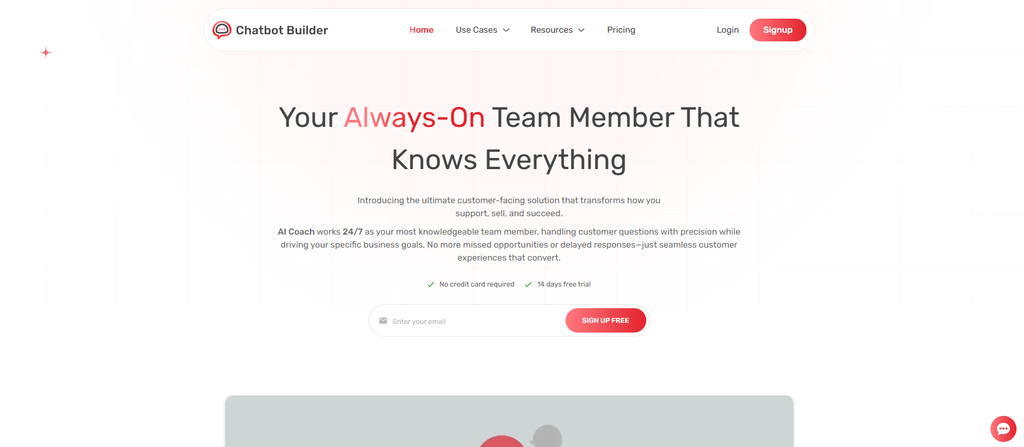
ChatbotBuilder.net lets you train an AI agent on your documents, past chats, and website URLs, then give it a business goal such as booking a call, driving a trial signup, or answering support questions. When a customer needs a person, the agent hands the conversation to your team. It can also take actions like reviewing subscriptions, scheduling meetings, and generating quotes, and a performance dashboard shows what to improve.
Your agent can run on a website chat embed, WhatsApp, Instagram, Facebook Messenger, Telegram, SMS, and WordPress. You can choose AI models from OpenAI, Claude, Gemini, and Grok, or connect your own API key.
What it costs: Flat monthly plans with a 14-day free trial and no credit card required.
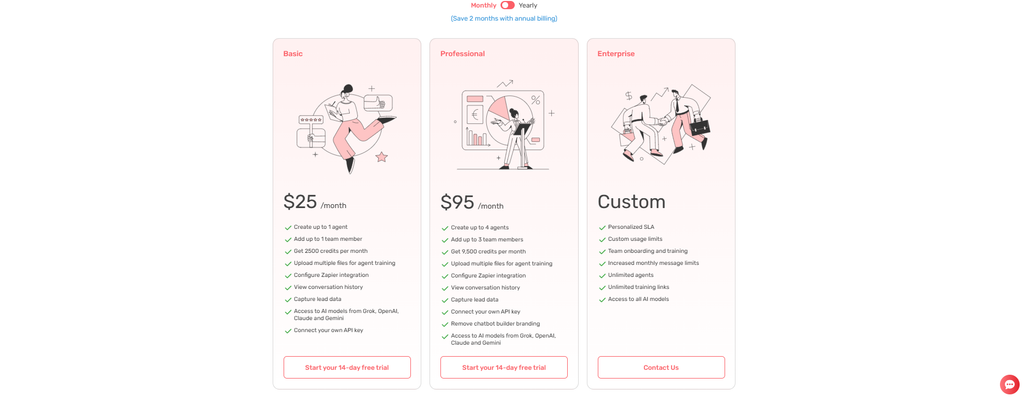
- Basic, $25 a month: 1 agent, 1 team member, 2,500 credits a month, file training, Zapier integration, conversation history, and lead capture
- Professional, $95 a month: 4 agents, 3 team members, 9,500 credits a month, and removal of ChatbotBuilder.net branding
- Enterprise, custom: personalized SLA, unlimited agents, custom usage limits, and team onboarding
Watch out for: Usage runs on credits, so estimate your monthly volume before choosing a plan. The platform is built around chat and messaging channels, so a phone-heavy contact center will want a voice specialist like Dialogflow CX.
2. Fin (formerly Intercom)
Best for: Support teams that want an AI agent live quickly.
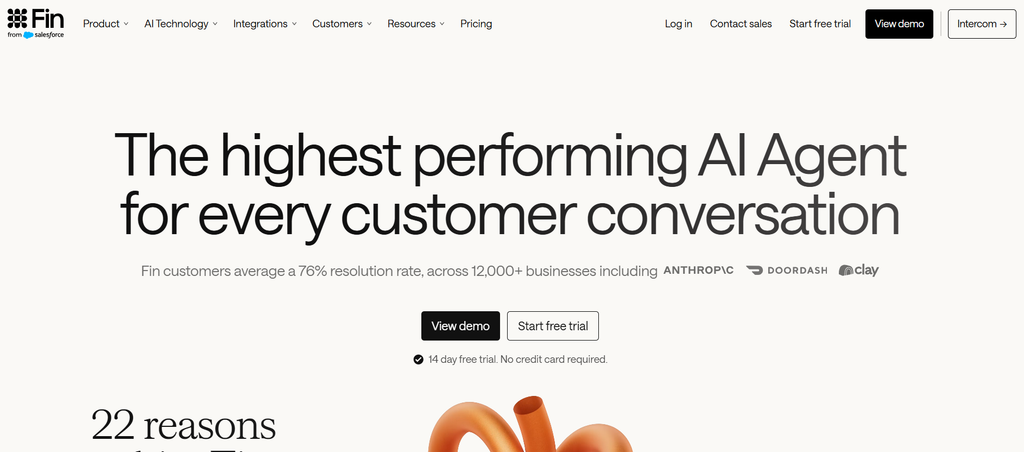
Fin answers customers across chat, email, voice, and social. It has a vendor-claimed average resolution rate of 76% and charges $0.99 per outcome. That claim comes from the vendor, so test it on your own content. Intercom’s Essential plan starts at $29 per seat per month billed annually, with Fin billed separately at $0.99 per resolution.
Watch out for: Costs climb with volume, and the pending Salesforce deal adds roadmap questions.
3. Zendesk AI agents
Best for: Companies already inside Zendesk.
Your tickets, macros, and knowledge base share one data set, so handoffs to human agents keep full context. Zendesk AI costs $1.50 per committed automated resolution or $2.00 pay as you go, on top of seat prices. Suite plans start at $55 per agent per month on annual billing.
Watch out for: Copilot, the agent assist product, is another $50 per seat. Budget for the full stack, not just seats.
4. Ada
Best for: Consumer brands with heavy support volume.
Ada focuses on automated resolution at scale across many channels and languages. If thousands of weekly questions are repetitive (returns, shipping, account access), it’s a strong candidate. One 2026 pricing roundup found an entry point around $2,500 a month at 3,000 chats, on annual contracts.
Watch out for: It’s built for volume, and small teams may find it more than they need.
5. Botpress
Best for: Teams with a developer who wants control.
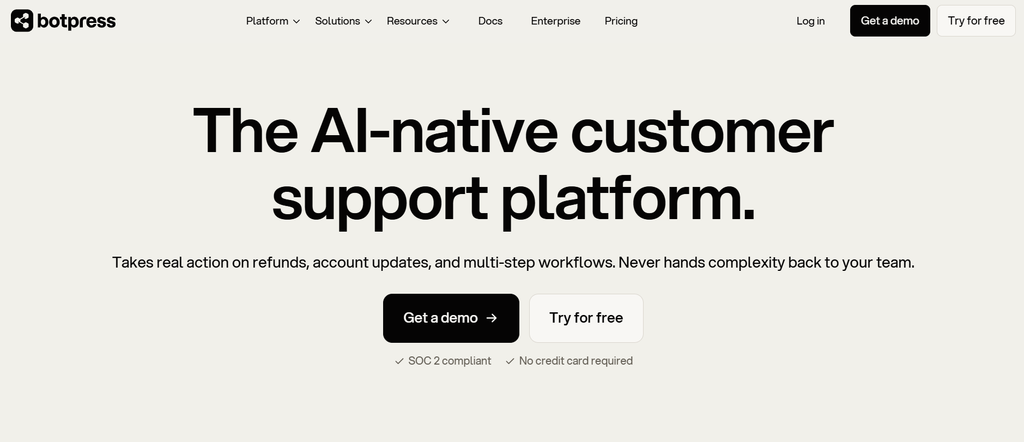
Botpress lets you build custom agents, wire in your own logic, and shape conversation flows. One independent analysis lists Plus at $89 a month and Team at $495. Other sources report $150 for Plus and $750 for Team on annual billing. Check the live pricing page.
Watch out for: More freedom means more setup. Budget time for building and testing.
6. Voiceflow
Best for: Product, design, and CX teams building conversations together.
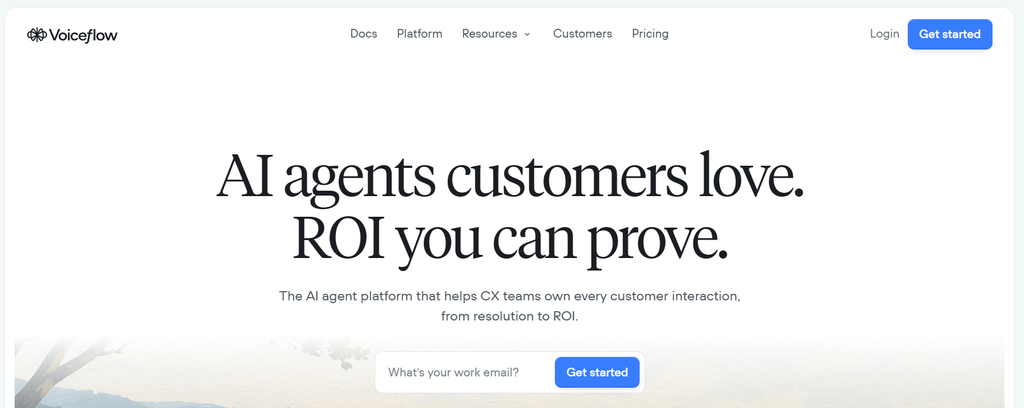
Voiceflow’s visual canvas lets non-developers map conversations, then hand them to engineers. It handles chat and voice. Pro costs $60 a month, and usage runs $0.005 per customer message plus model tokens. One analysis estimated about $140 a month for 3,000 chats on Pro.
Watch out for: Voiceflow’s 2026 restructure removed dollar amounts from its public pricing page, so confirm costs before you commit.
7. Kore.ai
Best for: Large companies with many use cases across customers and employees.
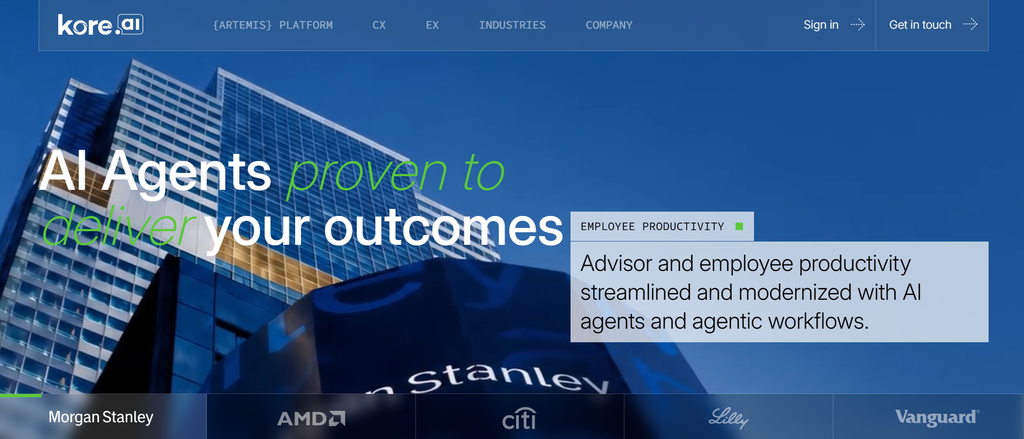
Kore.ai covers customer support, internal help desks, and voice on one platform, and enterprises with strict governance needs shortlist it early. Kore.ai bills per request, message, or session, so cost tracks volume rather than results.
Watch out for: It’s a big platform. Small businesses will pay for depth they won’t use.
8. Microsoft Copilot Studio
Best for: Businesses built around Microsoft 365 and Teams.
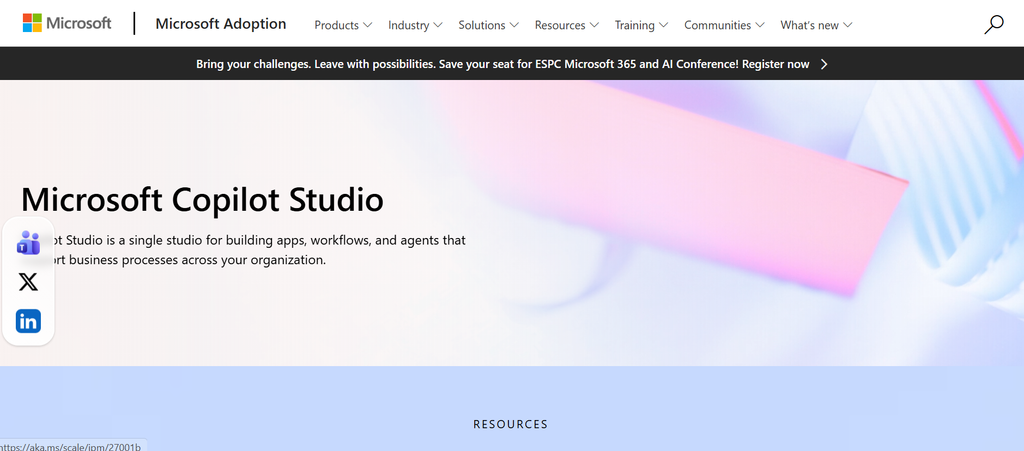
Copilot Studio suits internal assistants for HR or IT and customer agents that pull from Microsoft tools. Microsoft sells packs of 25,000 Copilot Credits at $200 a month, and employee usage is included for people licensed for Microsoft 365 Copilot.
Watch out for: The voice mode you choose changes the bill sharply. In one 12,000 minute example, classic voice cost $1,000 and generative voice cost $3,400.
9. Google Dialogflow CX
Best for: Voice heavy contact centers and teams on Google Cloud.
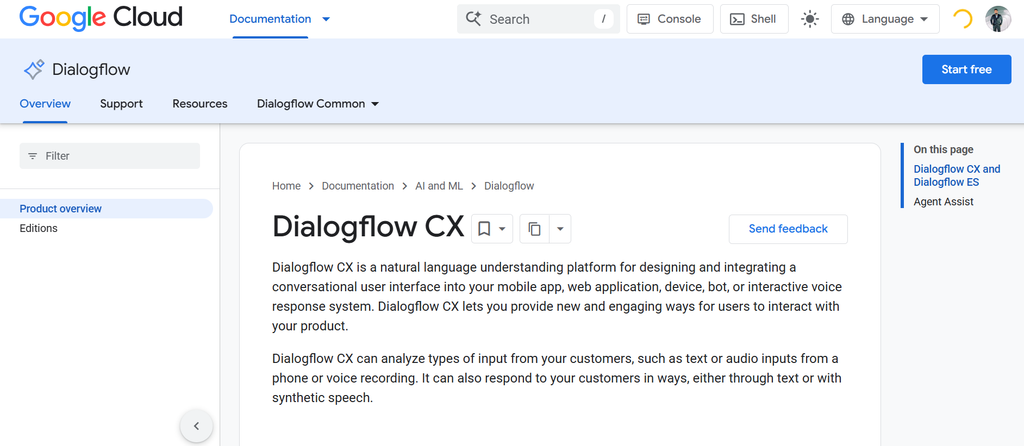
Dialogflow CX is a long time go to for structured, high volume voice and chat flows with solid tooling for complex paths. Google bills per request or session.
Watch out for: Expect a technical build. It rewards teams with engineering support.
Side by side Conversational AI Software Comparison
| Platform | Best for | Reported pricing model |
| ChatbotBuilder.net | Small and mid-size teams, no code bots on web and messaging | Flat monthly plans from $25, credit-based, 14-day free trial |
| Fin | Support teams, fast launch | $0.99 per outcome plus seats |
| Zendesk AI agents | Zendesk users | $1.50 to $2.00 per resolution plus seats |
| Ada | High volume consumer brands | Annual contract, around $2,500 a month entry |
| Botpress | Developer-led teams | Monthly plan plus AI usage |
| Voiceflow | Cross-functional design teams | Credits, $0.005 per message |
| Kore.ai | Enterprise | Per request or session |
| Copilot Studio | Microsoft 365 companies | Credit packs, $200 per 25,000 |
| Dialogflow CX | Voice on Google Cloud | Per request or session |
What it really costs: four worked examples
Sticker prices mislead. Run your own volume:
- ChatbotBuilder.net: $25 a month on Basic or $95 on Professional, with a set amount of monthly credits. Budgeting is simple, since you’re not charged per resolved chat.
- Fin, 1,000 conversations a month at 50% AI resolution: roughly $495 in Fin fees, on top of seat costs.
- Zendesk, 1,000 automated resolutions: $1,500 committed or $2,000 pay as you go, plus seats and add-ons.
- Voiceflow, 3,000 chats: about $140 a month on the estimate above, before heavier model usage.
Compare each against the Gartner contact cost: $13.50 for an assisted contact versus about a dollar for an AI resolution. Read how each vendor defines “resolved” too. One analysis warned that a $0.99 charge can land on a conversation where nothing got solved, simply because the customer never came back to complain.
A quick way to pick Best Conversational AI Software
Answer in order and stop at the first yes:
- Small team that wants a no-code bot trained on your own docs and live in under an hour? Start with ChatbotBuilder.net.
- Already on Zendesk? Try Zendesk AI agents.
- Want an AI agent on top of your current helpdesk with minimal setup? Look at Fin.
- Drowning in repetitive consumer questions? Test Ada.
- Have a developer and want control? Try Botpress.
- Need designers and support leads to build together? Voiceflow.
- Enterprise scale with heavy governance? Kore.ai.
- Microsoft shop? Copilot Studio.
- Voice first on Google Cloud? Dialogflow CX.
Four mistakes that sink most rollouts
- No human handoff. Think back to the 87% figure from Gartner. If a frustrated customer can’t reach a person, you’ve built an expensive way to lose them.
- Messy source content. The AI is only as good as what it reads. Outdated help articles produce outdated answers.
- Measuring the wrong number. Track resolution and satisfaction, not deflection.
- Going wide too early. Nail one use case, prove it, then expand.
The bottom line
Don’t chase the longest feature list. Pick one painful, repetitive use case, choose the platform that fits your existing tools, and launch small. Read the transcripts, fix what breaks, and grow from there.
Ready to build your first agent? Start your 14-day free trial at ChatbotBuilder.net, no credit card required, and keep exploring our guides and comparisons to match the right platform to your stack.
Frequently asked questions
What is conversational AI software?
Software that understands natural language and responds through chat or voice, and can take actions like checking orders or booking appointments.
How is it different from a chatbot?
Traditional chatbots follow scripts and buttons. Conversational AI reads intent, pulls from your content, and handles messy phrasing.
Do I need a developer?
Not always. ChatbotBuilder.net, Fin, and Zendesk get you live with little technical work. Botpress and Dialogflow CX reward engineering help.
Will customers accept it?
Most will, if a human is one step away. Gartner’s data shows the human option matters as much as the bot.
Will it replace my support team?
It takes repetitive questions off their plate, and your people handle the tricky, emotional, high value conversations.