


For those who operate in the Shopify store, it’s likely that your email inbox resembles the one from yesterday and further back in time. Lots of “where is my order?” emails, some size-related inquiries, and a few customers looking for a discount code are the rule rather than the exception. Nothing complicated here, but all of it wastes time that one could save for marketing efforts or even just fulfilling orders.
However, having a Shopify chatbot helps you to get rid of all this unnecessary workload. The right chatbot will help customers immediately, recommend various items, track orders, and operate long after your team has logged off for the night. If you acquire the wrong chatbot, it will disappoint users, be expensive, and become dormant after a month.
This article covers the main aspects of what a Shopify chatbot deals with and what adoption and revenue statistics say about it, as well as compares its major variations relative to their pricing and features.
What Is A Shopify Chatbot?
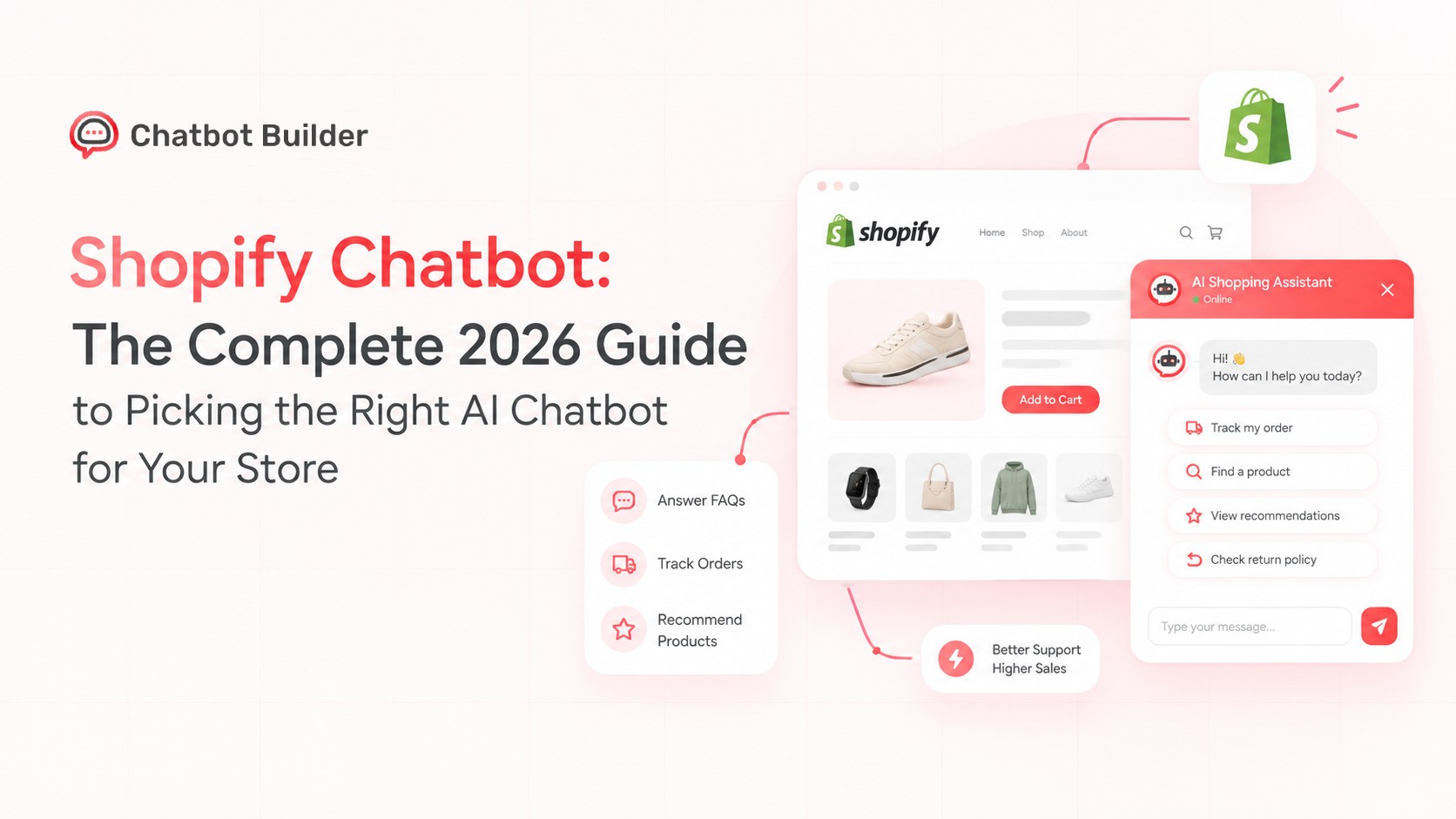
Shopify chatbot is a chat widget powered by artificial intelligence that helps businesses connect with their clients online and converse with them in real-time. Rather than generating answers that can be general, Shopify chatbot gathers live data from the backend of Shopify, such as information about products, order status, delivery possibilities, and return policies, so that every given answer is true.
Most tools on the market fall into three tiers:
– Rule-based bots. These follow a fixed decision tree. Although they are easily affordable and predictable, they fail the moment clients ask something that goes beyond the given code.
– AI Q&A bots. These bots are based on natural language processing that allows searching for answers in the knowledge base without any strict script.
– Full AI agents. These bots understand the context during the conversation, actually take actions (such as starting a return process or applying a discount), and grow due to the experience. This is where most of the market is heading in 2026.
The single biggest use case remains order tracking. Shoppers checking “where is my order” account for a large share of all support tickets on growing stores, and a well-trained AI agent can resolve the majority of those without a human ever touching the ticket.
The Market Data: Why Shopify Merchants Are Adopting Chatbots Fast
The numbers behind this shift are not small. As indicated by Grand View Research, the global market for chatbots is anticipated to be valued at approximately 11.8 billion U.S. dollars in 2026 and is poised to grow with a CAGR of 23.3 percent, reaching close to 27.29 billion dollars by 2030.
Retail and ecommerce are driving a meaningful share of that growth. Mordor Intelligence puts retail and ecommerce at roughly 28 percent of current chatbot market share, the largest single vertical tracked in its 2026 to 2031 market report.
Consumer behaviors validate these projections. The data from G2 shows that there is a rise of around 20 percent in the use of chatbots, with 82 percent of consumers preferring to interact with a bot as opposed to waiting in line to talk to a human being. According to DemandSage, the cost incurred by companies for communicating through chatbots is only 50 cents compared to more than 6 dollars for a conversation with a human agent.
Retail-specific spending tells a similar story. According to the information provided by Master of Code, investment in chatbots for retail is expected to rise from 12 billion U.S. dollars in 2023 to 72 billion U.S. dollars in 2028, which signifies an increase of six times in a span of five years.
Who Is Actually Using These Chatbots
Demographic data matters here because it shapes how you should design your bot’s tone and flow.
Millennials are still the most avid users of chatbots in the consumer segment. The research conducted by HappyFox shows that nearly 60 percent of millennials have already utilized a chatbot while making a purchase and that 70 percent of such consumers rate their experience positively. The users from this age group are twice as likely as older shoppers to use chatbots as personal shopping assistants for comparing products and getting recommendations as opposed to using them solely for dealing with customer service inquiries.
Gen Z shoppers push even further. Research compiled by Hyperleap’s 2026 AI chatbot statistics dashboard shows 89 percent of Gen Z shoppers (ages 18 to 25) prefer a chatbot for their first point of contact and are the least likely age group to ask for a human handoff.
The older generation of shoppers is also catching up faster than expected by many companies. The data from Hyperleap shows that 38 percent of baby boomers (58 and older) use chatbots, a 15 percent increase on a yearly basis, which is а faster growing segment compared to others.
The takeaway for Shopify merchants: chatbots are no longer a nice-to-have aimed at a younger audience. They are becoming the default first touch across nearly every customer age group.
How to Compare Shopify Chatbots: Price, Features, and What the Spec Sheet Hides
Every roundup of chatbot tools looks similar on the surface. What actually separates a good pick from a disappointing one comes down to four things.
- What the bot can do, not just what it can say: A basic Q&A bot answers from your help docs and stops there. A real AI agent integrates with the backend of your Shopify store to perform various functions such as obtaining details of a completed order, initiating a return, applying discounts, or changing the address of delivery. When you are in touch with vendors, don’t ask them simply for a demo; rather, request them to provide a list of actions which the bot will be able to carry out.
- How it handles a question it cannot answer: A well-built AI chatbot admits when it does not know something and routes the customer to a person with full context attached. A poorly built one guesses, which on a high-value order can do more damage than saying nothing at all.
- How the pricing actually bills: Many of the Shopify app makers claim that their service is available at low monthly fees, but you may find yourself paying additional fees for each transaction or ticket that is generated once you book several orders. A bot that is offered to you at $50/month can end up costing you $300/month.
- Whether it covers every channel your customers use: Chat only covers customers who chat. Despite the popularity of a bot among customers, many shoppers prefer using email, SMS, and phone calls when making big purchases. It is important to make sure that the messaging bot service covers this possibility and can operate outside the website widget.
Shopify Chatbot Comparison: Pricing and Best Fit
| Chatbot | Best for | Starting price | Free plan | Setup speed |
| ChatBotBuilder.net | Budget-conscious stores and agencies managing multiple brands | $25/month | 14-day trial | Live in about 30 minutes with templates |
| Tidio | All-in-one live chat plus AI widget | $29/month | Yes | Under an hour |
| Gorgias | Full helpdesk across chat, email, and social | $40/month | No | Half a day |
| Shopify Inbox | Free native chat with zero setup | Free | Yes | Already built in |
| Intercom Fin | Larger stores with complex, multi-step conversations | $39 per seat/month | No | A few hours |
| Zendesk AI | Enterprise teams already on Zendesk | US$ 19agent/month paid yearly | No | Multiple days |
| Chatty AI | Small stores on a tight monthly budget | $19.99/month | No | Under 10 minutes |
Pricing reflects publicly listed rates and may change. Always confirm current numbers on each provider’s site before purchasing.
Why ChatBotBuilder.net Is the Smart Pick for Shopify Stores
Most Shopify-specific chatbot apps are priced and built around a single storefront. That works fine if you run one brand and never plan to scale support beyond it. It works far less well if you are a growing store watching volume climb, or an agency that manages chat and lead automation across several client stores at once.
ChatBotBuilder.net was built for exactly that gap, and it shows up in three places.
- Straightforward, predictable pricing: Plans start at $25/month for the Starter tier and $95/month for Professional, with a custom Enterprise option for larger operations. There is a 14-day free trial on every plan, and unlike several competitors on the list above, you will not find a per-resolution or per-ticket surcharge quietly inflating your bill once traffic increases. For a store watching every dollar of customer acquisition cost, that kind of predictability matters.
- A genuinely fast path to launch: Pre-created templates can fast-track the work of the bot in less than 30 minutes, thanks to supporting many of the services used in e-commerce activities, including lead generation and FAQ automation. In order to benefit from the service, you do not need to have any technical skills or spend weeks getting onboarded.
- White label and multi-client support built in: This is where ChatBotBuilder.net separates itself most clearly from Shopify-only apps. It offers white label portals, unlimited client sub accounts, and custom branding, which makes it the strongest option on this list for agencies, consultants, or multi-brand ecommerce groups that need to deploy and manage chatbots across several stores from one dashboard, without paying for several separate subscriptions.
A Few Areas Where ChatBotBuilder.net Could Improve
Where it asks for a bit more patience is on advanced AI agent workflows, which carry a learning curve similar to most flexible, non-Shopify native builders, and its enterprise-level SLA guarantees sit on the top pricing tier rather than every plan. Voice channel support is also less mature than dedicated phone-focused tools. For the large majority of Shopify stores and the agencies serving them, though, the combination of price, setup speed, and white label flexibility makes ChatBotBuilder.net one of the best value picks available in 2026.
How to Implement a Chatbot to Your Shopify Store
In order to get started, you need to make a decision about the chatbot service that fits your needs the best.
- – Choose a platform based on your financial capabilities, requirements for Shopify built-in features, and the number of stores you need to handle.
- – Synchronize your store information with the chatbot so it has relevant information such as your product catalog details, order statuses, and your policy pages.
- – Get a ready template or design your own for your specific purpose—order tracking, lead generation, or product suggestion.
- – Personalize the chat window, including the logo, colors, and greetings from your store.
- – Train the AI on FAQs, product descriptions, and support scenarios. .
- – Test with real questions before going live. Ask the bot 10 to 15 things your customers commonly ask and fix any gaps.
Most stores are fully live within a single afternoon.
Conclusion
Selecting the right Shopify chatbot is all about aligning your business with the appropriate tool rather than just relying on the generic rating list. For instance, if you are a single store with a little turnover, you may use a simple free chatbot tool, while for a store with high sales volume only an advanced AI solution would do, like a chatbot capable of processing orders, managing returns, and forwarding requests to a human agent when necessary.
The market data backs up the urgency here. Adoption is climbing across every age group, cost per interaction is a fraction of live agent support, and shoppers increasingly expect a fast, accurate first response before they ever reach a human. Stores that get this right now are building a real advantage over the ones still relying on a static contact form.
If you want a reliable chatbot that will not cost you too much, it’s reasonable to choose ChatBotBuilder.net. Start with a single, well-trained workflow such as order tracking, measure the results, and expand from there once you see what it saves your team.
Frequently Asked Questions
What is the best chatbot for a Shopify store on a tight budget?
ChatBotBuilder.net offers the strongest balance of price and features starting at $25/month, while Shopify Inbox is the best fully free option with no add-on costs.
Do Shopify chatbots actually increase sales?
Yes. Industry data shows AI chatbots can lift conversion rates by up to 30 percent when used for proactive product recommendations, not only for support deflection, according to Chatbot.com research.
How long does it take to set up a chatbot on Shopify?
Most tools install in 10 to 30 minutes. ChatBotBuilder.net templates can have a working bot live in about 30 minutes without any coding required.
Can a Shopify chatbot handle returns and refunds?
Some can process them directly, including Gorgias and Intercom Fin. Others, including most entry-level bots, can only explain your return policy and point customers to a form.
Is a Shopify chatbot better than phone support?
Neither replaces the other. Chatbots handle high-volume text questions cheaply and instantly, while phone support still wins trust on higher-value purchases and older customer segments.