


Every conversation about chatbots with a business owner starts the same way. Somebody says “we need a bot,” and about ninety seconds later somebody else asks what it’s going to set them back. Fair question. It’s also annoying to research, because one vendor says free, another quotes $40,000, and a third won’t say anything until you’ve sat through a demo.
So, how much do chatbots cost? In 2026, the realistic range runs from nothing at all to well over $100,000. That’s a ridiculous spread, but it makes sense once you see what’s behind it. A bot that answers five questions on your website is a different animal from one that books appointments, talks to your CRM, takes payments, and speaks three languages.
This guide walks through the pricing models, the things that push a quote up or down, the costs people forget, and how to avoid overpaying.
The Short Version
If you only read one section, make it this one. These are ballpark figures based on common market pricing, and your actual quotes will vary.
| Route | Rough cost | Who it suits |
| Free plan on a no-code tool | $0 per month | Testing, very small shops |
| Paid no-code platform | $15 to $300 per month | Most small and mid-sized businesses |
| Enterprise software | $500 to $5,000+ per month | Big teams, heavy compliance needs |
| Freelancer build | $1,500 to $15,000 once | Narrow, specific custom logic |
| Agency or in-house build | $20,000 to $150,000+ | Deeply customized, integrated systems |
Most businesses we talk to end up in the second row. They don’t need a custom engineering project. They need something that works by next week.
How Vendors Actually Charge You
Pricing pages hide the real model behind friendly tier names. Knowing which model you’re looking at saves a lot of grief later.
Free and freemium plans: Good for kicking the tires. You’ll usually hit a cap on contacts, channels, or features fast, and some add the vendor’s branding to your bot. Think of it as a test drive rather than a place to live.
Monthly or annual subscriptions: The most common setup. You pay a flat fee, tiered by contacts, conversations, or channels. Annual plans often knock 15 to 20 percent off. The big advantage is predictability, since you know what next month’s invoice looks like.
Usage-based pricing: You pay per conversation or per message. WhatsApp works like this, with fees set by Meta that land on top of whatever your platform charges. It scales nicely when business is slow and can sting during a big sale.
Per-seat pricing: Mostly a helpdesk thing. Each human agent costs money. If your bot is supposed to lighten the load on your team, double-check you’re not still paying for a full roster of seats.
One-time development fees: The agency and freelancer model. You pay a big chunk upfront, then keep paying for hosting, fixes, and API usage afterward.
AI usage fees: If your bot calls a large language model, you’re typically billed by the token. Short, simple chats are cheap. Long conversations with lots of context add up quicker than you’d think.
How Much Do Chatbots Cost by Type?
The kind of bot you pick drives the price more than anything else, so it’s worth getting this choice right.
Rule-based bots follow scripts: buttons, menus, keyword triggers. They’re predictable and cheap. On a no-code platform, you can build one in an afternoon, and it’ll usually run you $0 to $100 a month. Hiring someone to build it pushes that to $1,500 to $5,000.
AI-powered bots understand free-form questions and write their own answers. They need a knowledge base, guardrails, and more computing power. Expect roughly $50 to $500 monthly on a platform, or $1000 to $5000 and up if you commission a custom one.
Hybrid bots mix the two. Scripted flows handle the predictable stuff (booking, lead qualification, order status) and AI picks up whatever doesn’t fit. In our experience, this is the sweet spot for most businesses. You get reliability where it matters and flexibility where it helps, and the price lands between the other two.
Voice bots answer phone calls. They add speech recognition, text-to-speech, and telephony charges, so custom versions can climb past $50,000 without much effort.
Why Two Quotes Can Look Nothing Alike
You can ask two vendors for “a chatbot” and get numbers that differ by a factor of ten. Usually it comes down to a handful of things.
Conversation complexity matters most. A bot that answers FAQs is cheap, while one that qualifies leads, books calls and hands off to a human takes real design work. Channels come next. Covering only your website costs less than running on WhatsApp, Instagram, Messenger and SMS at once, and each channel can bring its own setup and fees.
Integrations add up too. Hooking the bot to a CRM, store, calendar or payment gateway is where the value lives, but it also takes time or a higher plan. Volume, languages, and compliance round it out. A clinic that has to protect patient data will pay more than a bakery taking cake orders, and that’s just how it goes.
What Custom Development Really Involves
If you do go custom, it helps to see where the money disappears.
Discovery and planning usually run $1,000 to $10,000, covering requirements, conversation design, and architecture. Design and UX add $2,000 to $15,000. The development itself, meaning the backend, the AI layer and the channel connections, can cost anywhere from $5,000 to $80,000 or more. Integrations tack on $2,000 to $25,000, testing another $1,000 to $10,000, and launch and training up to $5,000.
Then the bill keeps coming. Budget something like 15 to 25 percent of the original build each year for hosting, updates, and monitoring. For a small business, that’s a heavy commitment for something a no-code tool can do for a fraction of the price. Custom is the right call when you have proprietary logic or old systems that need tight integration. It’s rarely the right call when you just want to answer customers faster.
The Costs Nobody Mentions Upfront
Ask how much chatbots cost and most people quote the subscription price. That’s usually the smallest part of the story. A few things regularly catch people off guard.
Messaging fees are the first. WhatsApp and some SMS providers charge per message or conversation, completely separate from your platform. AI usage is another, since token billing creeps up when conversations run long.
Then there’s your own time. Even with no-code tools, someone has to plan the flows and write the copy, and that someone isn’t free. The same goes for your knowledge base. An AI bot is only as good as the material you feed it, and gathering that material takes effort. Products change, prices change, policies change, so the bot needs regular upkeep too.
Don’t forget live agents either. If the bot escalates to humans, those humans still need to exist. And watch for overages. Blow past your contact limit, and you might get bumped to a pricier tier automatically.
The fix is boring but effective. Before signing anything, ask the vendor for a written breakdown covering channel fees, limits, and add-ons.
Where Chatbot Builder (CBB) Fits In
For businesses that want serious automation without an enterprise invoice, Chatbot Builder is built for exactly that. It’s a no-code platform for designing, launching, and managing chatbots across messaging channels, without hiring developers.
Here’s the budget angle. In a typical custom project, the biggest line item is developer labor. A visual builder removes most of it. Instead of paying an agency to build your flows and then paying again every time something changes, you edit the flow yourself in a few minutes. That alone changes the math on a first-year budget.
CBB also has a free trial, which takes some of the guesswork out. You can test it against your real use case before spending anything. The next section covers what you get.
A Closer Look at Chatbot Builder
Chatbot Builder is aimed at people who’d rather launch this month than next quarter, and who want costs they can predict.
A visual flow builder: You map conversations on a canvas the way you’d sketch them on a whiteboard. Drop in messages, buttons, questions, conditions and actions, then publish. No code, no developer queue, no hourly rates.
Multiple channels from one place: Rather than buying a separate tool for every platform, you can build for the channels your customers already use, such as WhatsApp, Instagram, Facebook Messenger and your website, from a single dashboard. Fewer tools usually means fewer subscriptions.
Lead generation and sales: Capture contact details, ask a few qualifying questions, send product info and pass warm leads to your sales team. Every conversation the bot handles is one your team doesn’t have to.
Support automation: Answer common questions instantly, any hour of the day, and route the tricky ones to a person. Ticket volume drops and response times improve without extra hiring.
Integrations and workflows: Connect the bot to the tools you already use so conversations feed straight into your normal processes. Check the CBB site for the current integration list.
Broadcasts and follow-ups: Where channel rules allow, you can send promotions, reminders and updates to your contacts. That’s how a chatbot stops being an expense and starts earning its keep.
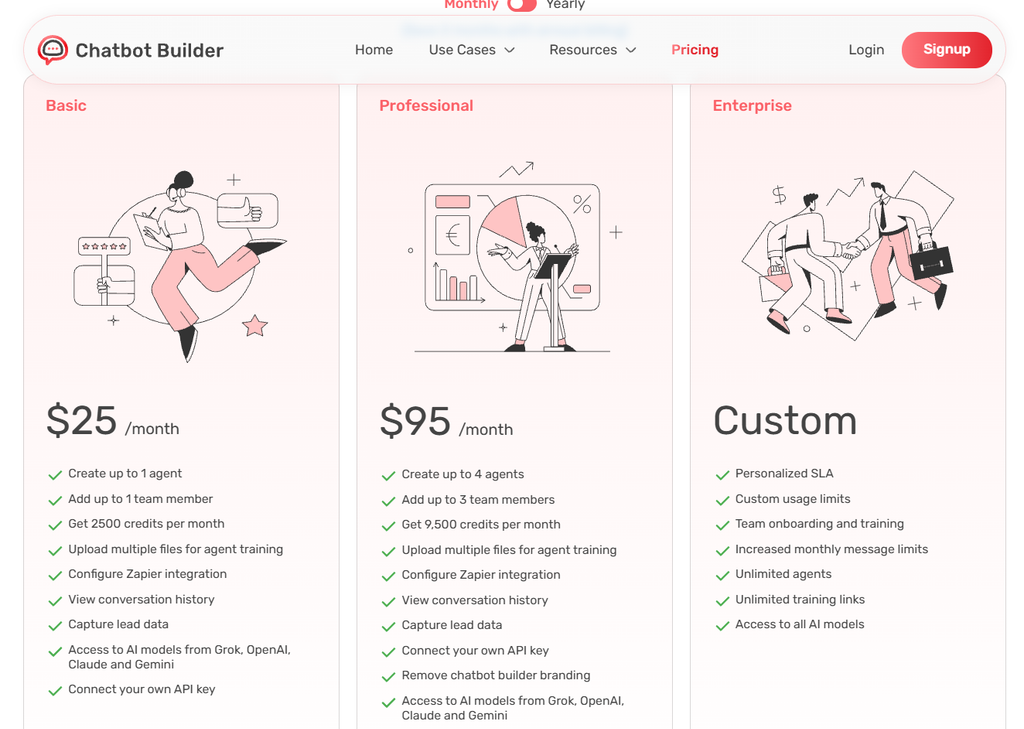
Pricing you can plan around: You pick a plan based on your volume instead of commissioning a five-figure project, and the 14-day free trial lets you see real results first. Current plans and features live at chatbotbuilder.net.
No-Code or Custom: Which Costs Less Over Time?
Take a small online store that wants a bot for order tracking, FAQs, and lead capture on WhatsApp and Instagram. This is hypothetical, but it’s a common setup.
A custom build might run $15,000 to $40,000 upfront, plus ongoing hosting and developer time whenever something needs changing. First-year totals of $20,000 to $50,000 wouldn’t surprise anyone. Automation can reduce customer service costs by up to 30%.
A no-code platform like CBB means a monthly subscription, some setup time on your end, and channel fees where they apply. The first-year total is usually a small fraction of the custom number, and you can edit things whenever you like without calling anyone.
Custom wins if you need proprietary logic or deep ties to legacy systems. For everything else, no-code is faster to launch, lower risk, and easier to change.
Work Out Your Own Budget
Rather than guessing, try this. Start by deciding what the bot is for: support, leads, bookings, or sales. Vague goals cause scope creep, and scope creep causes invoices.
Next, list your channels and estimate monthly conversations, since both drive your plan tier. Decide how much AI you need. A lot of businesses find that structured flows cover 80 percent of what customers ask. Then list every tool the bot has to connect with.
Finally, add a buffer of 10 to 20 percent for testing, content writing, and surprises, and run a small trial with real customers before you go big.
Is It Worth It? Measuring ROI
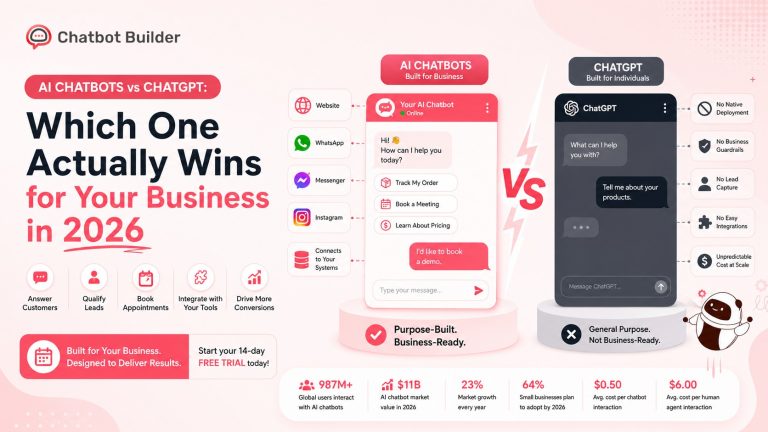
Knowing how much chatbots cost only gets you halfway, because the other half is what they bring back. Look at hours of agent time saved, the cost of a bot-handled conversation compared with a human-handled one, extra leads captured outside office hours, sales that started or finished in chat, and whether customers seem happier with faster replies. Industry research puts an AI chatbot interaction at roughly $0.50–$0.70, versus around $20–$25 for a human-handled ticket.
A simple formula works fine: take your monthly savings plus added revenue, subtract the monthly chatbot cost, and divide by that same cost. Even a modest bot that deflects a few hundred repetitive chats a month can pay for itself quickly.
Ways to Spend Less Without Cutting Corners
Start small. Launch with your ten most common questions and expand from there. Use hybrid flows so you’re only paying for AI where it earns its place. If you’re sure about a platform, annual billing saves real money. Keep an eye on conversation counts and message fees so overages don’t ambush you, build flows you can duplicate across channels, and review your analytics monthly. Cut what doesn’t convert and improve what does. And use free trials, always.
Conclusion: Try Chatbot Builder Free for 14 Days
How much do chatbots cost? The honest answer is “it depends,” but it doesn’t have to stay a mystery. Rule-based and hybrid bots on a no-code platform can be surprisingly affordable. Custom AI builds are a bigger investment and make sense mainly when your needs are unusual. The best way to find your own number is to try the thing with your own customers rather than squinting at a pricing page.
That’s what Chatbot Builder is for. You get a visual builder, multi-channel support, and tools for lead generation and customer support, and you can have a working bot live in days instead of months, with no developer invoice.
Ready to see what a chatbot could do for your business? Sign up for the Chatbot Builder 14-day free trial and build your first bot today.
Frequently Asked Questions
1. How much do chatbots cost for a small business?
Most small businesses spend somewhere between $0 and $300 a month on a no-code platform, depending on contacts, channels, and features. Custom builds are rarely needed at this stage and can run into the thousands. A free trial lets you confirm the fit before you spend anything.
2. Are free chatbots good enough?
For testing an idea or handling very low volume, yes. Limits on contacts, features, and branding tend to push growing businesses toward a paid plan, so it’s smart to trial a full-featured platform and see what you actually need.
3. What ongoing costs should I plan for after launch?
Your subscription or hosting fee, messaging charges such as WhatsApp fees, AI usage if you use it, and time for updating content and flows. For custom bots, set aside around 15 to 25 percent of the build cost each year. That’s the real answer to how much do chatbots cost once the launch excitement fades.
4. Is an AI chatbot more expensive than a rule-based one?
Generally, yes. AI bots need more setup, knowledge-base prep, and usage fees. Many businesses get the best value from a hybrid, with structured flows for predictable tasks and AI only where flexibility matters.
5. Can I try Chatbot Builder before paying?
Yes. Chatbot Builder offers a 14-day free trial, so you can build, test, and launch a bot with your real use case before choosing a plan. Sign up at chatbotbuilder.net.