


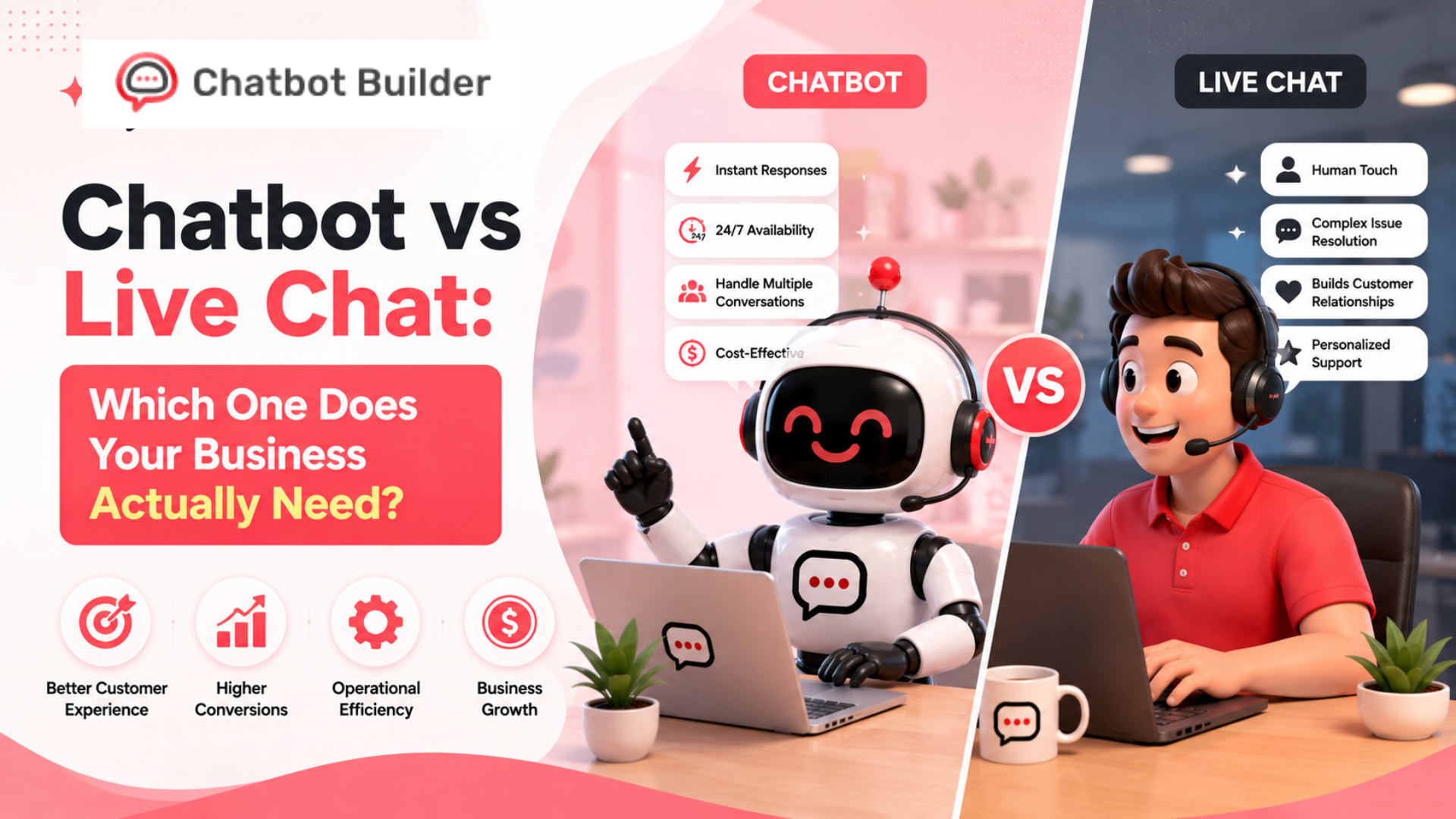
Chatbot vs Live Chat: Which One Does Your Business Actually Need?
Here’s a conversation almost every website owner has with themselves at some point: do we need a chatbot, a live chat team, or is the contact form still doing its job? It’s a reasonable question to sit with, and honestly, most businesses guess wrong at least once before they land on a setup that actually works.
Here’s the thing, though. Chatbot and live chat aren’t really competing against each other. Both are built for different jobs. One’s about coverage and speed, handling a lot of ground at once. The other’s about depth, trust, the kind of moment where a canned answer just won’t cut it. So the real question isn’t which one is “better.” It’s which one your business needs right now, and at what point you’ll probably need both.
Below, we’ll go through what each one does, where each pulls ahead, a table comparing them head to head, and a simple way to figure out what fits your business based on size, support volume, and how complicated your sales process gets.
Chatbot vs Live Chat: What Most Businesses Get Wrong
A lot of businesses treat the chatbot vs live chat decision like a one-time purchase instead of an ongoing fit question. They pick whichever one a competitor uses, or whichever one a sales rep pitched hardest, and never revisit it as the business grows. Revisit the chatbot vs. live chat decision whenever your traffic, support volume, or average deal size changes significantly. The solution that works for 50 visitors a day rarely works for 5,000.
What a Chatbot Actually Does

A chatbot is software that talks to your visitors, using preset rules, decision trees, or (more and more these days) AI models that can actually parse what someone’s asking, which is really the starting point for the whole chatbot vs live chat conversation. It doesn’t clock out, doesn’t need coffee breaks, and nobody has to manage it hour to hour.
At the basic end, it’s answering the stuff people ask constantly: shipping timelines, pricing, return policy, hours. Push it further, and it starts qualifying leads, asking a few questions, then routing people based on the answers. Some bots will book a meeting straight onto a rep’s calendar. Others integrate with your CRM and automatically update records, so your team never loses information between a visitor’s first click and their first real conversation.
What a chatbot really gives you comes down to a few things: it’s always there, it doesn’t cost more to handle more people, and it keeps the first few minutes of every interaction consistent. And if you’ve ever had two reps give two different answers to the same question, you know why that consistency actually matters more than it sounds like it should.
Modern chatbots sound far more natural than they did just a few years ago. Natural language processing means people can just type what they mean instead of clicking through a menu, and the thing usually still figures out what they’re after. Still, at the end of the day it’s pattern matching. Great at volume, great at repetition. Not built for the weird one-off situation, and that’s fine, because that was never really its job to begin with.
What Live Chat Actually Does
Live chat means an actual person is on the other end, a support rep or salesperson, typing back in real time through a widget on your site, which is the other half of the chatbot vs live chat equation. No script to work through. The visitor types whatever’s actually on their mind, and a human reads it, gets the nuance, and responds the way a person would.
This matters most when the answer isn’t a simple lookup. Someone asking what your refund policy is? Chatbot question, easy. Someone asking why their refund got denied when the policy seems to say it shouldn’t have been? That’s a live chat question. The gap between those two is judgment, and that’s something a script just can’t fake.
Live chat also does something for trust that automation struggles with. When someone’s about to spend real money- a SaaS contract, a big B2B deal, a major purchase- they often want proof there’s an actual person behind the company. A well-timed, thoughtful response from a human at the right moment in a sales conversation can genuinely be the thing that keeps someone from bouncing.
The catch is cost and availability. A person handles one conversation at a time, maybe three or four if they’re good at juggling. They need training, breaks, a salary. Live chat just doesn’t scale the way a bot does, and it can’t run unattended at 3 am without either paying for a night shift or leaving visitors hanging.
Where Chatbots Win
Three areas, really: being available around the clock, qualifying leads, and handling scale.
- Round-the-clock coverage. Your site doesn’t shut its doors at 6 pm, and your visitors don’t either. Someone poking around your pricing page at 2 am on a Saturday still deserves an answer, and short of paying for overnight staff, a chatbot’s the only realistic way to make that happen. This matters even more when your visitors span multiple time zones, because a global audience doesn’t recognize “off hours.”
- Qualifying leads. Not everyone who lands on your site is ready to talk to sales, and honestly, not everyone should be taking up a rep’s time. A bot can ask the qualifying questions upfront: budget, timeline, team size, use case, and only pass along the promising ones. That keeps your sales team’s time going toward conversations that might actually close instead of window shoppers.
- Scale. A chatbot can run a thousand conversations at once without blinking. Run a seasonal business, launch a big campaign, get an unexpected traffic spike from somewhere- a chatbot just absorbs it. No scrambling to hire and train people overnight. This is probably the single biggest cost advantage it has over live chat, and it’s why most growing businesses end up needing one eventually.
These three strengths, coverage, qualification, and scale, are usually the deciding factor when chatbot vs live chat comes down to pure economics.
Where Live Chat Wins
Live chat pulls ahead whenever things get complicated, expensive, or emotional.
- Complex questions. If someone’s issue involves a bunch of moving parts, an account-specific quirk, a technical integration question, something that doesn’t fit a preset flow, a human’s going to sort it out faster and more accurately than a bot guessing at intent. Trying to jam a messy support issue through a chatbot usually just annoys the customer and adds a step before they get to a human anyway.
- High-value conversations. Enterprise deals, big-ticket purchases, anything with real back-and-forth negotiation- these do better with an actual person involved. Someone about to make a significant financial decision wants to feel heard, and wants room to ask something unexpected and get a real answer, not a link to a help article.
- Emotional situations. Someone upset about a billing mistake or a service that let them down doesn’t want a decision tree. They want to feel heard, and they want it fixed, and that’s just not something automation can pull off. Get this wrong with a bot, and you can do real damage to a relationship that a decent human conversation could’ve saved.
This is where chatbot vs live chat stops being about cost and starts being about outcome.
Chatbot vs Live Chat: Side-by-Side Comparison
| Factor | Chatbot | Live Chat |
| Response time | Instant, 24/7 | Fast during staffed hours, delayed or unavailable outside them |
| Cost | Low ongoing cost after setup; no added headcount for volume | Higher ongoing cost; scales with headcount and hours covered |
| Scalability | Handles unlimited simultaneous conversations | Limited by number of agents available |
| Lead qualification | Strong; consistent, rule-based qualification at scale | Strong but resource-intensive; depends on agent skill and availability |
| Support quality | Good for repetitive, well-defined questions | Excellent for nuanced, complex, or emotional issues |
| Setup time | Can take longer upfront to build flows and train the bot | Faster to launch; mainly requires staffing and training, agents |
Neither side of this table wins outright. It really just depends on what you’re optimizing for at this point in your business: cost and coverage, or depth and trust.
Chatbot vs Live Chat: The Real Cost Picture
The chatbot vs live chat cost comparison looks simple on paper: low ongoing cost versus scaling headcount, but the full picture is more nuanced. A chatbot that’s poorly configured can quietly cost you conversions by frustrating visitors who need a human. Live chat that’s understaffed can cost you the same way, just through long wait times instead of bad automation. When you’re weighing chatbot vs live chat purely on price, factor in the cost of a bad experience, not just the subscription or salary line.
Chatbot vs Live Chat: How Customer Expectations Have Shifted
Customer expectations around chatbot vs live chat have changed a lot in the last few years. Visitors are generally fine starting a conversation with a bot, as long as they know a human is available if things get complicated. What they don’t tolerate well is a chatbot pretending to be human, or a live chat option that’s advertised but never actually staffed. Being upfront about which one a visitor is talking to at any given moment matters more for trust than which one you actually chose.
How Customer Expectations Have Shifted
Customer expectations around chatbot vs live chat have changed a lot in the last few years. Visitors are generally fine starting a conversation with a bot, as long as they know a human is available if things get complicated. What they don’t tolerate well is a chatbot pretending to be human, or a live chat option that’s advertised but never actually staffed. Being upfront about which one a visitor is talking to at any given moment matters more for trust than which one you actually chose.
A Decision Framework: What Does Your Business Actually Need?
Instead of picking based on whatever’s trending, it helps to just work through three questions honestly.
1. What’s your business size?
Small businesses and solo founders usually can’t justify a full-time live chat hire, especially for coverage outside business hours. A chatbot handling FAQs and basic qualification tends to be the smarter first move, since it fills gaps a small team just can’t physically cover.
Mid-size businesses usually end up needing both: a bot for the front line and lead qualification, live chat available during business hours for anything that needs a real judgment call.
Bigger businesses and enterprises generally need both running at once, well integrated, with clear rules for when a bot conversation should get handed off to a person.
2. What’s your support volume?
Getting hit with a lot of repetitive questions, shipping status, account setup, pricing? A chatbot will save your team a huge amount of time just by soaking up that volume before it ever reaches a human inbox.
Lower volume but each ticket tends to be more involved? Live chat, or a hybrid where the bot handles the routine stuff and flags anything complicated, usually serves customers better here.
3. How complex are your sales conversations?
If your product’s simple and low-cost, a chatbot can often qualify and even close leads on its own, no human required.
If you’re selling something complex, expensive, or requiring a custom quote, live chat (or a bot that qualifies and then hands off) is going to convert better, because buyers at that price point usually expect, or need, a real conversation before they commit.
When to Use Both Together
For most growing businesses, the chatbot vs live chat debate resolves itself once you realize it’s not either/or. It’s both, working together, with a clean handoff between them.
Here’s what a good setup usually looks like: the chatbot greets every visitor, answers the common stuff instantly, and asks a few qualifying questions along the way. If the conversation’s simple and the bot’s got what it needs, it resolves it. When things get complicated, the visitor seems frustrated, or the lead looks like it’s worth a rep’s time, the bot hands it off to a live agent, ideally with the context already passed along so nobody has to repeat themselves.
This hybrid setup gets you the best of both: round-the-clock coverage and scale from the bot, human judgment and trust exactly where it counts. It also frees up your team to spend time on conversations that actually need them instead of getting buried under questions a bot could’ve handled in seconds.
This is exactly the gap ChatbotBuilder is built to close. Instead of treating chatbot and live chat like two separate systems bolted together, ChatbotBuilder lets you build a bot that handles the repetitive front-line work and qualifies leads on its own, then hands off cleanly to a live agent when a conversation actually needs a human, carrying the visitor’s context along so nobody starts from zero. If you’re trying to figure out where that line should sit for your own business, it’s worth seeing how the handoff actually plays out rather than guessing at it on paper.
Chatbot vs Live Chat: Common Mistakes to Avoid
The most common chatbot vs live chat mistake is picking one and never revisiting the choice. A close second is running a chatbot with no clear escalation path, leaving frustrated visitors stuck in a loop with no way to reach a person. On the live chat side, the biggest mistake is advertising 24/7 support without actually staffing it round the clock, which does more damage to trust than just being upfront about business hours.
The Bottom Line
Chatbot vs live chat isn’t really a competition. It’s about matching the right tool to the right moment. Chatbots win on coverage, cost, qualification, and scale. Live chat wins on nuance, trust, and the conversations that really matter. The businesses that get this right usually aren’t picking one over the other. They’re building a setup where the bot handles what it’s good at, the human handles what only a human can, and the two hand off to each other without friction.
Start by being honest about your business size, how much support volume you’re actually dealing with, and how complex your sales conversations really get. That’s usually enough to point you toward where to start, and whether it’s time to bring in the other piece too.
Sign up for the free trial here and start optimizing your business operations today!
Frequently Asked Questions
What is the main difference between a chatbot and live chat?
A chatbot uses automation, rules, or AI to respond to visitors instantly, while live chat connects visitors with a real human agent in real time. Chatbots are better for repetitive questions and lead qualification at scale. Live chat is better for complex, high-value, or emotionally sensitive conversations.
Is a chatbot cheaper than live chat?
Generally yes. A chatbot has a setup cost but low ongoing costs regardless of conversation volume, while live chat requires paying agents whose capacity scales linearly with headcount and hours staffed.
Can a chatbot replace live chat entirely?
For most businesses, no. Chatbots handle routine, repetitive questions well but struggle with nuanced or emotionally charged situations that benefit from human judgment. Most businesses get the best results using both together, with a chatbot for first-line coverage and live chat for escalations.
Which is better for lead qualification, chatbot or live chat?
Chatbots are typically more efficient for lead qualification because they can ask consistent qualifying questions to every visitor at any hour, then route only promising leads to a human. Live chat can also qualify leads well, but it’s limited by agent availability and capacity.
When should a business add live chat instead of just using a chatbot?
Businesses should add live chat when their sales conversations are complex or high-value, when support issues require nuanced human judgment, or when customer trust at a critical decision point matters more than instant automated responses.